Ritwik_BlueStamp_Portfolio
Knee Rehabilitation Device - BSE Summer
Project maintained by ritwikc35 Hosted on GitHub Pages — Theme by mattgraham
Knee Rehabilitation Device
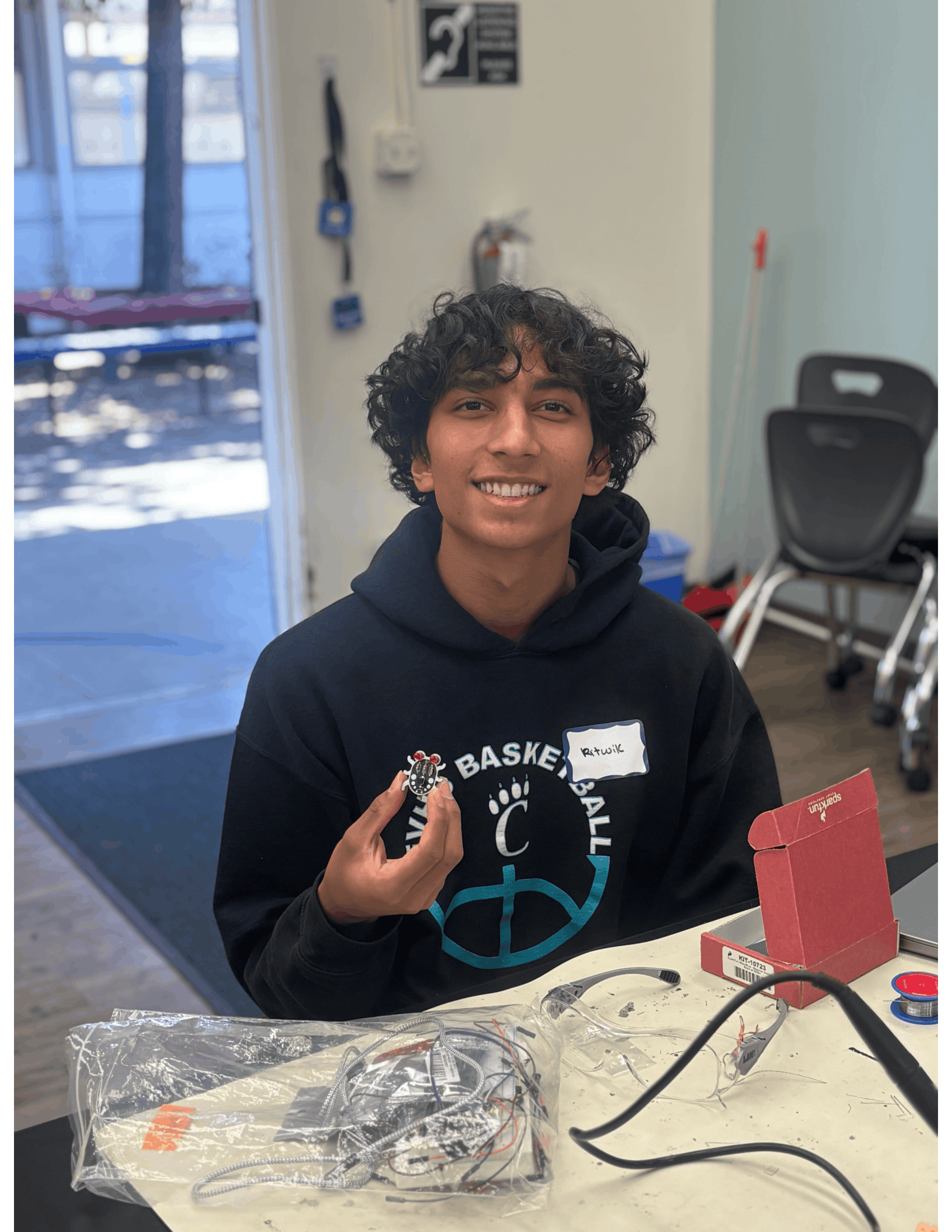
This project is a wearable knee rehabilitation device that helps people perform squats with safe, correct form during recovery. Built around an ESP32 microcontroller, it uses a flex sensor to track how deep the knee bends and an accelerometer + gyroscope to detect when the knee caves inward, sounding a buzzer in real time so the user can correct themselves instantly. The biggest challenge was translating messy, noisy sensor data into reliable feedback: it took lots of testing and calibration to figure out which sensor readings actually corresponded to a good squat versus a bad one, but landing on a system that counts reps, tracks range of motion, and catches bad form the moment it happens made all the debugging worth it.
| Engineer | School | Area of Interest | Grade |
|---|---|---|---|
| Ritwik C | Evergreen Valley High School | Computer Science | Incoming Junior |
Modifications
Modifications Descripton
- I did three modifications
- One of them was the fabric flap that goes around all the electronic parts. I made it a velcro strap and sewed it down on on end so it can be removed
- Another one was integrating LED lights to the system that detects a poor squat. Now, instead of only audible feedback on squats (buzzer), there is now visual feedback as well. The green LED is lit when the user’s squat is good so far. It switches to a red LED when the user’s knee is caving in, or when they reached the bottom of their squat. This provides visual feedback on the user’s squat form
- The third one was integrating levels of difficulty in the squat. The first level (changed with buttons) is the easiest - the flex sensor allows the least amount of bend. The second level is medium - the flex sensor allows more bend. The third level is the hardest - the flex sensor allows the most bend. Essentially, the threshold for the flex sensor’s bend increases as the levels increase.
Struggles/Challenges
- These modifications were slightly challenging since I had never wired LED’s before. I had to learn to on my own, and especially since polarity matters greatly, it was tedious to wire these LEDs in
- I also learned more about resistors and how they work, and how different types of resistors affect current
- Additionally, coding the levels button was tough since I had to learn how to code buttons.
- Finally, I had to learn to sew and it took tons of trial and error when practicing sewing. I eventually got a final product I was very happy with.
Code
#include <Adafruit_LSM6DS3TRC.h>
#include <BLEDevice.h>
#include <BLEServer.h>
#include <BLEUtils.h>
#include <BLE2902.h>

Adafruit_LSM6DS3TRC lsm6ds;

// ---------- BLE (Nordic UART Service) ----------
#define SERVICE_UUID  "6E400001-B5A3-F393-E0A9-E50E24DCCA9E"
#define CHAR_UUID_TX  "6E400003-B5A3-F393-E0A9-E50E24DCCA9E"
#define CHAR_UUID_RX  "6E400002-B5A3-F393-E0A9-E50E24DCCA9E"

BLECharacteristic *pTxCharacteristic;
bool deviceConnected = false;

class MyServerCallbacks : public BLEServerCallbacks {
  void onConnect(BLEServer *pServer)    { deviceConnected = true; }
  void onDisconnect(BLEServer *pServer) {
    deviceConnected = false;
    pServer->startAdvertising();
  }
};

void sendBoth(String msg) {
  Serial.print(msg);
  if (deviceConnected) {
    pTxCharacteristic->setValue(msg.c_str());
    pTxCharacteristic->notify();
  }
}

// ---------- Pins ----------
#define FLEX_PIN   32
#define BUZZER_PIN 13
#define RED_LED    25
#define GREEN_LED  26
#define BUTTON_PIN 27

// ---- LEVEL SYSTEM ----
// Higher level = more bend allowed before it warns.
const int LEVEL_THRESHOLDS[3] = { 210, 300, 400 };   // level 1, 2, 3
int currentLevel = 0;                                 // 0-indexed: 0=L1, 1=L2, 2=L3

// ---- Flex over-bend ----
const int OVERBEND_CONFIRM_COUNT = 2;
const int FLEX_SAMPLES = 50;

// ---- Squat detection (X axis) ----
const float SQUAT_X_THRESHOLD = 9;

// ---- Cave detection (Z axis) ----
const float CAVE_Z_THRESHOLD = 6;

// ---- Consecutive-reading confirmation ----
const int CAVE_CONFIRM_COUNT = 2;

const int SAMPLES = 5;

int caveStreak     = 0;
int overBendStreak = 0;

bool lastButtonState = HIGH;   // for button edge detection

unsigned long lastBLEStatus = 0;
const unsigned long BLE_STATUS_INTERVAL = 1000;

void setLEDs(bool green, bool red) {
  digitalWrite(GREEN_LED, green ? HIGH : LOW);
  digitalWrite(RED_LED,   red   ? HIGH : LOW);
}

// Beep N times to announce the level (1 beep = L1, 2 = L2, 3 = L3)
void announceLevel(int level) {
  for (int i = 0; i <= level; i++) {
    digitalWrite(BUZZER_PIN, HIGH);
    setLEDs(false, true);
    delay(100);
    digitalWrite(BUZZER_PIN, LOW);
    setLEDs(true, false);
    delay(150);
  }
}

void setup() {
  Serial.begin(115200);
  while (!Serial) delay(10);
  pinMode(BUZZER_PIN, OUTPUT);
  pinMode(RED_LED, OUTPUT);
  pinMode(GREEN_LED, OUTPUT);
  pinMode(BUTTON_PIN, INPUT_PULLUP);
  setLEDs(true, false);
  Wire.begin(21, 22);
  if (!lsm6ds.begin_I2C()) { Serial.println("Sensor not found!"); while (1) delay(10); }

  BLEDevice::init("KneeRehab");
  BLEServer *pServer = BLEDevice::createServer();
  pServer->setCallbacks(new MyServerCallbacks());
  BLEService *pService = pServer->createService(SERVICE_UUID);
  pTxCharacteristic = pService->createCharacteristic(
                        CHAR_UUID_TX, BLECharacteristic::PROPERTY_NOTIFY);
  pService->createCharacteristic(CHAR_UUID_RX, BLECharacteristic::PROPERTY_WRITE);
  pTxCharacteristic->addDescriptor(new BLE2902());
  pService->start();
  pServer->getAdvertising()->addServiceUUID(SERVICE_UUID);
  pServer->getAdvertising()->start();
  Serial.println("BLE ready - connect to 'KneeRehab'");

  Serial.print("Starting at LEVEL 1 (limit ");
  Serial.print(LEVEL_THRESHOLDS[0]);
  Serial.println(") - press button to change level");
}

void beepInward() {
  setLEDs(false, true);
  for (int i = 0; i < 2; i++) {
    digitalWrite(BUZZER_PIN, HIGH); delay(120);
    digitalWrite(BUZZER_PIN, LOW);  delay(120);
  }
}

void buzzOverBend() {
  setLEDs(false, true);
  digitalWrite(BUZZER_PIN, HIGH);
  delay(600);
  digitalWrite(BUZZER_PIN, LOW);
}

void loop() {
  // --- Button: cycle level 1 -> 2 -> 3 -> 1 ---
  bool buttonNow = digitalRead(BUTTON_PIN);
  if (lastButtonState == HIGH && buttonNow == LOW) {   // just pressed
    currentLevel = (currentLevel + 1) % 3;
    sendBoth(">>> LEVEL " + String(currentLevel + 1)
             + "  (limit " + String(LEVEL_THRESHOLDS[currentLevel]) + ")\n");
    announceLevel(currentLevel);
    delay(50);   // debounce
  }
  lastButtonState = buttonNow;

  // The active threshold for this level
  int flexLimit = LEVEL_THRESHOLDS[currentLevel];

  // --- Flex sensor: heavy averaging ---
  long flexSum = 0;
  for (int i = 0; i < FLEX_SAMPLES; i++) {
    flexSum += analogRead(FLEX_PIN);
    delay(1);
  }
  int flexRaw = flexSum / FLEX_SAMPLES;

  // --- Accelerometer: averaged X, Y, Z ---
  float xAvg = 0, zAvg = 0, yAvg = 0;
  for (int i = 0; i < SAMPLES; i++) {
    sensors_event_t a, g, t;
    lsm6ds.getEvent(&a, &g, &t);
    xAvg += a.acceleration.x;
    zAvg += a.acceleration.z;
    yAvg += a.acceleration.y;
    delay(5);
  }
  xAvg /= SAMPLES;
  zAvg /= SAMPLES;
  yAvg /= SAMPLES;

  bool inSquat = (xAvg < SQUAT_X_THRESHOLD);

  // --- STANDING OVERRIDE ---
  if (!inSquat) {
    caveStreak = 0;
  }

  bool caving = inSquat && (zAvg < CAVE_Z_THRESHOLD);
  if (caving) caveStreak++; else caveStreak = 0;

  // --- Over-bend uses the CURRENT LEVEL's threshold ---
  bool overBent = (flexRaw > 0) && (flexRaw < 4095) && (flexRaw > flexLimit);
  if (overBent) overBendStreak++; else overBendStreak = 0;

  // --- LED state: green by default, red on any fault ---
  bool fault = caving || overBent;
  setLEDs(!fault, fault);

  // --- Build status line ---
  String status = "L" + String(currentLevel + 1)
                + " (lim " + String(flexLimit) + ")"
                + " | FlexRaw: " + String(flexRaw)
                + " | X: " + String(xAvg, 2)
                + " | Y: " + String(yAvg, 2)
                + " | Z: " + String(zAvg, 2);
  if (!inSquat)      status += "  -> STANDING";
  else if (caving)   status += "  -> SQUATTING WHILE CAVING!";
  else               status += "  -> SQUAT (good)";

  Serial.println(status);

  if (millis() - lastBLEStatus > BLE_STATUS_INTERVAL) {
    if (deviceConnected) {
      pTxCharacteristic->setValue((status + "\n").c_str());
      pTxCharacteristic->notify();
    }
    lastBLEStatus = millis();
  }

  // --- Fault 1: knee caving inward ---
  if (caveStreak >= CAVE_CONFIRM_COUNT) {
    sendBoth(">>> KNEE CAVING INWARD!\n");
    beepInward();
    caveStreak = 0;
  }

  // --- Fault 2: bent too far (level-dependent) ---
  if (overBendStreak >= OVERBEND_CONFIRM_COUNT) {
    sendBoth(">>> OVER-BEND! Come back up.\n");
    buzzOverBend();
    overBendStreak = 0;
  }

  delay(20);
}
Final Milestone
Milestone 3 Descripton
- Milestone 3 was sewing all the components down to the knee sleeve using neoprene fabric, recalibrating every single sensor, and streaming all the session data via Bluetooth to an iPhone
- The circuiting all stayed the same, and it is consistent with the schematic.
- I sewed a flap down to the electronic parts so that nothing electronic was sticking out and everything was protected, however it is secured with velcro, so whenever any changes need to be made, you can unstrap the flap, fix anything, and then strap it back on
- The flex sensor is now sewn to the back of the knee sleeve, and the IMU is mounted on the breadboard itself.
Struggles/Challenges
- This milestone featured a myriad of challenges, such as figuring out what axis of the IMU corresponded to the knee caving inward, figuring out how to mount each sensor without tape, and soldering the flex sensor to wiring so that it could extend to the back of the knee
- Additionally, it was difficult learning how to sew and working with velcro since both of these were new to me
- Whenever the IMU shifted even slightly, the threshold values would change and it would mess up the detection system
- Finally, figuring out how to mount the flex sensor such that it would bend correctly was a big challenge - I tried tape, fabric, and finally settled on sewing it down
- With lots of trial and error, and figuring out how to mount everything properly, I was able to overcome each one
Modification ideas
- A couple modification ideas I have are to set levels (level 1, 2, 3, etc.) where as the levels increase, the flex sensor will allow a greater bend, increasing the difficulty of the squat
- Additionally, I want to add a green and red LED to introduce visual feedback instead of just audio
#include <Adafruit_LSM6DS3TRC.h>
#include <BLEDevice.h>
#include <BLEServer.h>
#include <BLEUtils.h>
#include <BLE2902.h>

Adafruit_LSM6DS3TRC lsm6ds;

// ---------- BLE (Nordic UART Service) ----------
#define SERVICE_UUID  "6E400001-B5A3-F393-E0A9-E50E24DCCA9E"
#define CHAR_UUID_TX  "6E400003-B5A3-F393-E0A9-E50E24DCCA9E"
#define CHAR_UUID_RX  "6E400002-B5A3-F393-E0A9-E50E24DCCA9E"

BLECharacteristic *pTxCharacteristic;
bool deviceConnected = false;

class MyServerCallbacks : public BLEServerCallbacks {
  void onConnect(BLEServer *pServer)    { deviceConnected = true; }
  void onDisconnect(BLEServer *pServer) {
    deviceConnected = false;
    pServer->startAdvertising();   // allow reconnect
  }
};

// Send a line to both Serial and BLE
void sendBoth(String msg) {
  Serial.print(msg);
  if (deviceConnected) {
    pTxCharacteristic->setValue(msg.c_str());
    pTxCharacteristic->notify();
  }
}

// ---------- Pins ----------
#define FLEX_PIN   32   // analog input from flex sensor divider
#define BUZZER_PIN 13   // active buzzer

// ---- Squat detection (X axis) ----
const float SQUAT_X_THRESHOLD = 9.0;   // X below this = squat, above = standing

// ---- Cave detection (Z axis) ----
const float CAVE_Z_THRESHOLD = -2.0;   // while squatting, Z below this = caving

// ---- Flex over-bend (raw values) ----
const int FLEX_UPPER_LIMIT = 1900;   // raw reading = bent too far
const int FLEX_LOWER_LIMIT = 320;    // raw reading = bent too far (other direction)

// ---- Consecutive-reading confirmation ----
const int CAVE_CONFIRM_COUNT = 2;    // caving reads in a row needed to buzz

const int SAMPLES = 5;   // light averaging

int caveStreak = 0;      // counts consecutive caving readings

// ---- BLE status streaming rate limit ----
unsigned long lastBLEStatus = 0;
const unsigned long BLE_STATUS_INTERVAL = 1000;  // send status once per second

void setup() {
  Serial.begin(115200);
  while (!Serial) delay(10);
  pinMode(BUZZER_PIN, OUTPUT);
  Wire.begin(21, 22);
  if (!lsm6ds.begin_I2C()) { Serial.println("Sensor not found!"); while (1) delay(10); }

  // --- BLE setup ---
  BLEDevice::init("KneeRehab");
  BLEServer *pServer = BLEDevice::createServer();
  pServer->setCallbacks(new MyServerCallbacks());
  BLEService *pService = pServer->createService(SERVICE_UUID);
  pTxCharacteristic = pService->createCharacteristic(
                        CHAR_UUID_TX,
                        BLECharacteristic::PROPERTY_NOTIFY
                      );
  pService->createCharacteristic(
    CHAR_UUID_RX,
    BLECharacteristic::PROPERTY_WRITE
  );
  pTxCharacteristic->addDescriptor(new BLE2902());
  pService->start();
  pServer->getAdvertising()->addServiceUUID(SERVICE_UUID);
  pServer->getAdvertising()->start();
  Serial.println("BLE ready - connect to 'KneeRehab'");

  Serial.println("Ready - start squatting!");
}

// Two short beeps = knee caving inward
void beepInward() {
  for (int i = 0; i < 2; i++) {
    digitalWrite(BUZZER_PIN, HIGH); delay(120);
    digitalWrite(BUZZER_PIN, LOW);  delay(120);
  }
}

// Long continuous buzz = bent too far
void buzzOverBend() {
  digitalWrite(BUZZER_PIN, HIGH);
  delay(600);
  digitalWrite(BUZZER_PIN, LOW);
}

void loop() {
  // --- Flex sensor: raw reading ---
  int flexRaw = analogRead(FLEX_PIN);

  // --- Accelerometer: averaged X and Z ---
  float xAvg = 0, zAvg = 0;
  for (int i = 0; i < SAMPLES; i++) {
    sensors_event_t a, g, t;
    lsm6ds.getEvent(&a, &g, &t);
    xAvg += a.acceleration.x;
    zAvg += a.acceleration.z;
    delay(5);
  }
  xAvg /= SAMPLES;
  zAvg /= SAMPLES;

  bool inSquat = (xAvg < SQUAT_X_THRESHOLD);
  bool caving  = inSquat && (zAvg < CAVE_Z_THRESHOLD);

  // --- Track consecutive caving readings ---
  if (caving) {
    caveStreak++;
  } else {
    caveStreak = 0;
  }

  // --- Build the status line ---
  String status = "Flex: " + String(flexRaw)
                + " | X: " + String(xAvg, 2)
                + " | Z: " + String(zAvg, 2);
  if (!inSquat)      status += "  -> STANDING";
  else if (caving)   status += "  -> SQUATTING WHILE CAVING!";
  else               status += "  -> SQUAT (good)";

  // Always print to Serial (when on laptop)
  Serial.println(status);

  // Send status to BLE only once per second (so it doesn't flood)
  if (millis() - lastBLEStatus > BLE_STATUS_INTERVAL) {
    if (deviceConnected) {
      pTxCharacteristic->setValue((status + "\n").c_str());
      pTxCharacteristic->notify();
    }
    lastBLEStatus = millis();
  }

  // --- Fault 1: knee caving inward (needs consecutive confirmation) ---
  if (caveStreak >= CAVE_CONFIRM_COUNT) {
    sendBoth(">>> KNEE CAVING INWARD!\n");
    beepInward();
    caveStreak = 0;
  }

  // --- Fault 2: flex sensor bent too far ---
  if ( (flexRaw > FLEX_UPPER_LIMIT) || (flexRaw < FLEX_LOWER_LIMIT) ) {
    sendBoth(">>> OVER-BEND! Come back up.\n");
    buzzOverBend();
  }

  delay(50);
}
Second Milestone
Milestone 2 Descripton
- Milestone 2 was a big step - all the electronic components are now on the knee sleeve using tape
- In the future, these components will all be sewn down in a much more aesthetically pleasing fashion
- This milestone featured a lot of coding challenges, especially in programming the Adafruit sensors (accelerometer, gyroscope) in order to determine whether the user’s knee was caving in during a squat with bad form
- The flex sensor being mounted to the back of the knee was a design choice that I made after trying it on various different locations - on the back allowed for the most precision and accuracy when determening knee bend
Struggles/Challenges
- It took lots of trial and error determening different axis values, and even the correct point on the knee sleeve to mount the sensors
- I didn’t understand at first how I was going to connect everything to the knee sleeve and have it working initially - now with trial and error and persistance, I was able to figure out a way.
Milestone 3 Ideas
- Milestone three will involve sewing all the components to the knee sleeve, integrating a session tracker (reps, sets, etc) into the code, streaming session data over bluetooth/wifi to a handheld device, and ensuring the wires are all secure and that none will come off easily.
Second Milestone Code
#include <Adafruit_LSM6DS3TRC.h>
Adafruit_LSM6DS3TRC lsm6ds;

// ---------- Pins ----------
#define FLEX_PIN   32   // analog input from flex sensor divider
#define BUZZER_PIN 13   // active buzzer

// ---- Squat detection (X axis) ----
const float SQUAT_X_THRESHOLD = 9.0;   // X below this = squat, above = standing

// ---- Cave detection (Z axis) ----
const float CAVE_Z_THRESHOLD = -2.0;   // while squatting, Z below this = caving

// ---- Flex over-bend (raw values) ----
const int FLEX_UPPER_LIMIT = 2070;   // raw reading = bent too far
const int FLEX_LOWER_LIMIT = 320;    // raw reading = bent too far (other direction)

// ---- Consecutive-reading confirmation ----
const int CAVE_CONFIRM_COUNT = 2;    // caving reads in a row needed to buzz

const int SAMPLES = 5;   // light averaging

int caveStreak = 0;      // counts consecutive caving readings

void setup() {
  Serial.begin(115200);
  while (!Serial) delay(10);
  pinMode(BUZZER_PIN, OUTPUT);
  Wire.begin(21, 22);
  if (!lsm6ds.begin_I2C()) { Serial.println("Sensor not found!"); while (1) delay(10); }
  Serial.println("Ready - start squatting!");
}

// Two short beeps = knee caving inward
void beepInward() {
  for (int i = 0; i < 2; i++) {
    digitalWrite(BUZZER_PIN, HIGH); delay(120);
    digitalWrite(BUZZER_PIN, LOW);  delay(120);
  }
}

// Long continuous buzz = bent too far
void buzzOverBend() {
  digitalWrite(BUZZER_PIN, HIGH);
  delay(600);
  digitalWrite(BUZZER_PIN, LOW);
}

void loop() {
  // --- Flex sensor: raw reading ---
  int flexRaw = analogRead(FLEX_PIN);

  // --- Accelerometer: averaged X and Z ---
  float xAvg = 0, zAvg = 0;
  for (int i = 0; i < SAMPLES; i++) {
    sensors_event_t a, g, t;
    lsm6ds.getEvent(&a, &g, &t);
    xAvg += a.acceleration.x;
    zAvg += a.acceleration.z;
    delay(5);
  }
  xAvg /= SAMPLES;
  zAvg /= SAMPLES;

  bool inSquat = (xAvg < SQUAT_X_THRESHOLD);
  bool caving  = inSquat && (zAvg < CAVE_Z_THRESHOLD);

  // --- Track consecutive caving readings ---
  if (caving) {
    caveStreak++;
  } else {
    caveStreak = 0;
  }

  // --- Print everything ---
  Serial.print("Flex: ");   Serial.print(flexRaw);
  Serial.print(" | X: ");   Serial.print(xAvg, 2);
  Serial.print(" | Z: ");   Serial.print(zAvg, 2);
  if (!inSquat)      Serial.print("  -> STANDING");
  else if (caving)   Serial.print("  -> SQUATTING WHILE CAVING!");
  else               Serial.print("  -> SQUAT (good)");
  Serial.println();

  // --- Fault 1: knee caving inward (needs consecutive confirmation) ---
  if (caveStreak >= CAVE_CONFIRM_COUNT) {
    Serial.println(">>> KNEE CAVING INWARD!");
    beepInward();
    caveStreak = 0;
  }

  // --- Fault 2: flex sensor bent too far ---
  if ( (flexRaw > FLEX_UPPER_LIMIT) || (flexRaw < FLEX_LOWER_LIMIT) ) {
    Serial.println(">>> OVER-BEND! Come back up.");
    buzzOverBend();
  }

  delay(50);
}
First Milestone
Milestone 1 Descripton
- For my first milestone, I built and wired the Adafruit arduino, gyroscope, and temperature sensors through the ESP-32 development board, with a breadboard
- I wired in a flex sensor and buzzer as well using jumper wires, Ohm resistors, and two breadboards that I had to combine together
- The flex sensor and Adafruit return values generated by the sensors within the components, that are analyzed by Arduino IDE and then feedback is provided in real time.
- Through Arduino IDE, I coded the components such that when the Adafruit’s accelerometer and gyroscope detect a tilt that is greater than a certain angle, the buzzer will sound. This simulates the knee caving in while performing a squat. Additionally, if the flex sensor detects a flex that is greater than the allowed bend, the buzzer will sound with a different sound pattern than the knee caving in alarm.
Struggles/Challenges
- A few challenges I faced was using the breadboard for the first time hands-on: the ESP-32 used was slightly too wide for one breadboard, so it took a few iterations to wire the ESP-32 along with the rest of the components in a way that was aesthetically clean and also the easiest to work with.
Milestone 2 Ideas
- The next milestone and the rest of the plan to complete this project includes integrating this hardware with a knee sleeve, and ensuring all the components do their job when the user is performing a squat.
First Milestone Code
#include <Adafruit_LSM6DS3TRC.h>
#include <Adafruit_LIS3MDL.h>

Adafruit_LSM6DS3TRC lsm6ds;
Adafruit_LIS3MDL lis3mdl;

// ---------- Pins ----------
#define FLEX_PIN   32   // analog input from flex sensor divider
#define BUZZER_PIN 13   // active buzzer

// ---------- Thresholds (RAW values, no angle math) ----------
const int FLEX_UPPER_LIMIT = 2070; // raw reading that means "bent too far"
const int FLEX_LOWER_LIMIT = 700;  // raw reading that means "bent too far"
const float INWARD_THRESHOLD = 5.0;   // accelerometer side-tilt

void setup() {
  Serial.begin(115200);
  while (!Serial) delay(10);

  pinMode(BUZZER_PIN, OUTPUT);
  Wire.begin(21, 22);

  if (!lsm6ds.begin_I2C()) {
    Serial.println("LSM6DS3TR-C not found - check wiring!");
    while (1) delay(10);
  }
  if (!lis3mdl.begin_I2C()) {
    Serial.println("LIS3MDL not found - check wiring!");
    while (1) delay(10);
  }
  Serial.println("Sensors ready.");
}

// Long continuous buzz = bent too far
void buzzOverBend() {
  digitalWrite(BUZZER_PIN, HIGH);
  delay(600);
  digitalWrite(BUZZER_PIN, LOW);
}

// Two short beeps = knee caving inward
void beepInward() {
  for (int i = 0; i < 2; i++) {
    digitalWrite(BUZZER_PIN, HIGH);
    delay(120);
    digitalWrite(BUZZER_PIN, LOW);
    delay(120);
  }
}

void loop() {
  // --- Flex sensor: raw reading, no conversion ---
  int flexRaw = analogRead(FLEX_PIN);

  // --- Accelerometer: side-to-side tilt ---
  sensors_event_t accel, gyro, temp;
  lsm6ds.getEvent(&accel, &gyro, &temp);
  float sideTilt = accel.acceleration.x;

  // --- Print both so you can see what's happening ---
  Serial.print("Flex raw: ");        Serial.print(flexRaw);
  Serial.print("  |  SideTilt: ");   Serial.print(sideTilt);
  Serial.println(" m/s^2");

  // --- Trigger 1: flex sensor bent past the raw limit ---
  if ( (flexRaw > FLEX_UPPER_LIMIT) || (flexRaw < FLEX_LOWER_LIMIT) ) {
    Serial.println(">>> OVER-BEND! Come back up.");
    buzzOverBend();
  }

  // --- Trigger 2: knee caving inward (already working) ---
  if (sideTilt > INWARD_THRESHOLD) {
    Serial.println(">>> KNEE CAVING INWARD! Fix form.");
    beepInward();
  }

  delay(100);
}
Starter Project
Starter Project Description
- For my starter project, I built the Weevil eye. It works by having a photo sensor determine whether there is light nearby, and when it detects darkness, the transistor captures this signal and provides current to the LEDs through the resistors in order for the LEDs to light up.
- I soldered the parts together (The LEDs, the transistor, the photo sensor, Ohm resistors, and battery holder.
- It was a good introductory to working with electrical parts and it built the foundation I needed to work on my main project.
Struggles/Challenges
- A few challenges that I faced when building my starter project were having to de-solder parts that I put in with incorrect polarity, I ended up fixing it.
Schematic
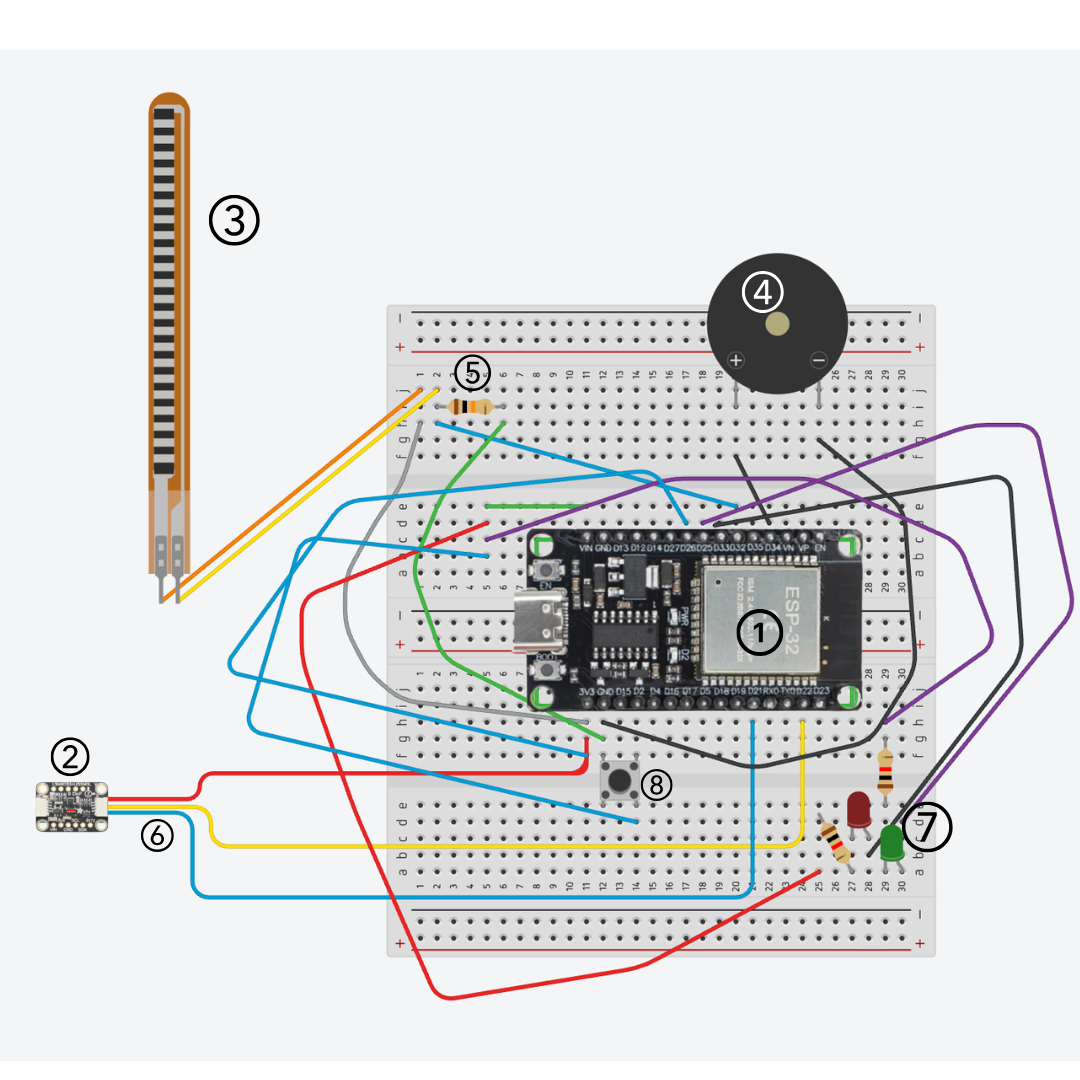
Labels:
- ESP-32 Microcontroller. This microcontroller is the brains of the entire circuit, and it bridges the gap of the communication between the laptop delivering the code and the other sensors/parts in the circuit.
- Adafruit Adafruit LSM6DS3TR-C + LIS3MDL (IMU - Gyroscope + Accelerometer). This sensor tracks translational acceleration and position in three axes, and the gyroscope measures angular velocity in three axes. This was used to determine whether the knee is caving inwards during a squat or not, using the IMU.
- Flex Sensor. This sensor has particles lined up within the length of the body, and as the flex sensor bends, the particles’ distance between each other increases. When this distance increases, the resistance pulling these particles back together also increases. The sensor tracks this resistance, and determines the value for the flex sensor dependent on how bent it is.
- Active Buzzer. Gets current from breadboard and ESP-32 to, when prompted, create a beeping sound. This sound cannot be altered pitch or frequency wise, however what can be altered is the buzzing pattern. I used this to differentiate the improper form caused by knee caving versus over-bend.
- 10k Ω Resistor. This resistor is used to limit the current from the ESP-32 to the Flex Sensor to prevent a short circuit.
- STEMMA QT / Qwiic JST SH 4-pin cable. This cable is used to connect into the Adafruit IMU. It has four cables - Red, Black, Blue, and Yellow. Red goes to power (3V3), Black goes to ground (GND), and Blue and Yellow go to the D21 and D22 pinouts in the microcontroller.
- LEDs. These Red and Green LEDs are used to provide visual feedback to the user and are a part of my modifications. They are wired to Ground and Pinout, and they require 560 Ohm resistors.
- Button. This button sets the levels for the difficulty of each squat.
Bill of Materials
| Part | Note | Price | Link |
|---|---|---|---|
| 2.1 x 3.2 in Breadboard | Wiring together the microcontroller and sensors | $2.99 | Link |
| ESP32 CP2102 | Microcontroller allowing all the sensors to communicate (WiFi, Bluetooth) | $9.39 | Link |
| Power bank | External power for the system | $9.99 | Link |
| STEMMA QT / Qwiic JST SH 4-pin cable (50mm) | Connect Adafruit sensor to ESP-32 | $0.95 | Link |
| 10K Ohm Resistor | Provide current resistance to flex sensor | $0.75 | Link |
| Adafruit LSM6DS3TR-C + LIS3MDL | Accelerometer + gyroscope to detect knee caving or bad form | $19.95 | Link |
| Electromagnetic Active Buzzer 5V | Make a beep sound when bad form is detected or lowest squat position is reached | $0.95 | Link |
| Jumper Wires | Connect all the sensors, buzzers, and controllers via the breadboard | $1.95 | Link |
| Knee Compression Sleeve | Mount all electronic equipment to straddle the knee on this | $12.99 | Link |
| Flex Sensor 4.5” | Detect a bend and send current to the buzzer when a specific bend is reached | $12.95 | Link |
| Neoprene fabric | Used to sew all the components down to the knee sleeve | $25.99 | Link |